Water Damage Restoration Seattle

Basement and Crawl-Space Flood Recovery Seattle

Seattle's below-grade flooding follows two patterns. Older homes in Ballard, Wallingford, and the Central District often have unfinished crawl spaces with dirt floors and a plastic vapor barrier, when groundwater rises…

Get My Free Estimate →
Basement and Crawl-Space Flood Recovery in Seattle, WA
Quick answer
  • Included: water extraction, mud/debris removal, structural drying with air movers and dehumidifiers, antimicrobial treatment, moisture readings before sign-off.
  • Speed: crews mobilize same day in most Seattle ZIP codes; active drying then runs 3 to 7 days with daily moisture checks.
  • Cost: Seattle basement and crawl-space recovery generally lands in the $2,000, $9,500 range; a ballpark, with the exact figure confirmed on a free on-site visit.
  • What we take: saturated fiberglass batts, wet vapor barrier, ruined drywall bottom-cuts, and standing debris hauled off site.
  • How to book: call and describe the water source and depth; a technician confirms scope on site before any work starts.

Seattle's below-grade flooding follows two patterns. Older homes in Ballard, Wallingford, and the Central District often have unfinished crawl spaces with dirt floors and a plastic vapor barrier, when groundwater rises during a November atmospheric river or a cracked lateral backs up, water pools on the barrier and soaks the fiberglass batts stapled to the joists above it. Finished basements in Green Lake, West Seattle, and Beacon Hill flood differently: water wicks up drywall, ruins baseboards, and saturates carpet padding and subfloor. The recovery method changes with the space, which is why an on-site look matters more than a phone quote.

Recovery runs in a set sequence. First, standing water is pumped and vacuum-extracted, a crawl space holding 2 inches of water over 800 square feet is roughly 1,000 gallons. Second, saturated insulation and vapor barrier are cut out and bagged, because wet fiberglass never dries in place and traps moisture against the wood. Third, air movers and LGR dehumidifiers run continuously; a typical Seattle crawl space needs 2 to 4 dehumidifiers pulling moisture until framing reads at or below 16% on a pin meter, the threshold the IICRC S500 standard uses for structural wood. Fourth, an antimicrobial is applied to exposed joists and subfloor to block mold, which starts colonizing damp wood within 24 to 48 hours. Fifth, moisture is documented daily until the space is dry.

A basement flood involving sewage or a backed-up side sewer is a Category 3 event, Seattle's clay laterals crack under old maple roots along streets like those in Wedgwood and Ravenna, and that water carries contaminants, so porous materials get removed rather than dried. Clean groundwater intrusion is less aggressive and more of it can be dried and saved. Recovery is not the same as waterproofing: recovery dries and restores what flooded, while stopping the next flood needs a sump pump, French drain, or exterior grading handled separately.

Decision-fit is straightforward. If a crawl space took clean groundwater and framing is still under 16% moisture, drying in place with insulation replacement is the lower-cost path, roughly $2,000, $4,500. If a finished basement flooded with contaminated water and drywall wicked more than a foot up the wall, expect demolition of the lower drywall band, carpet and pad disposal, and a higher figure. The trade-off is cost against certainty, drying in place is cheaper but only works when moisture readings and contamination category both allow it.
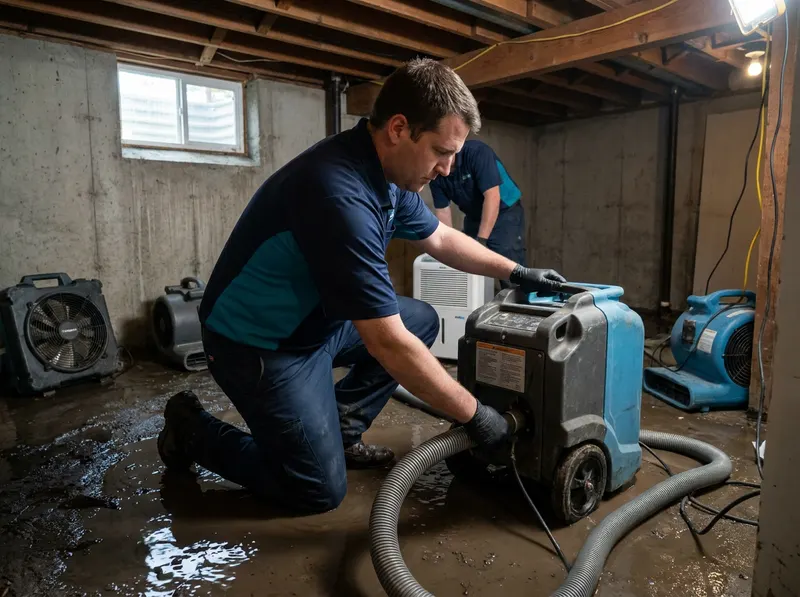
Basement and Crawl-Space Flood Recovery cost in Seattle

Crawl-space clean-water extraction + drying$2,000, $4,500
Finished basement clean-water recovery$3,500, $7,000
Category 3 / sewage basement recovery$5,000, $9,500
Insulation + vapor barrier replacement (crawl space)$1,200, $3,000
Daily equipment + monitoring (per day, drying phase)$150, $400

Every job gets a firm, written price after a free on-site visit.

Common questions

How fast can a crew reach a flooded basement in Seattle?
Same-day mobilization is standard across most Seattle neighborhoods, including West Seattle, Green Lake, and Beacon Hill. Faster extraction limits how far water wicks into subfloor and drywall, since mold begins on damp wood within 24 to 48 hours.
Does Seattle groundwater keep flooding a crawl space during winter?
Yes, Seattle's wet season runs roughly October through April, and high groundwater along low-lying areas near Green Lake and the Duwamish can re-enter a crawl space repeatedly. Flood recovery dries and restores the space; a sump pump or French drain, priced separately, addresses recurring intrusion.
Why remove wet insulation instead of drying it in a Seattle crawl space?
Wet fiberglass batts in a Seattle crawl space hold water against the joists and never fully dry in place, which is why saturated insulation and vapor barrier are cut out and replaced. Removal exposes the framing so air movers and dehumidifiers can pull it below 16% moisture.
Is a flooded Seattle basement covered by homeowners insurance?
Coverage depends on the water source; in Seattle, a burst supply line is often covered while groundwater seepage and sewer backup frequently need separate riders. Documented moisture readings and itemized scope from the recovery help support a claim, though the insurer decides payment.
What does basement and crawl-space flood recovery cost in Seattle?
Seattle basement and crawl-space flood recovery generally ranges from $2,000 to $9,500, driven by water depth, square footage, and whether the water was clean or contaminated. That figure is a ballpark; the exact price is confirmed during a free on-site assessment.

Get started today

Tell us about your basement and crawl-space flood recovery job in Seattle and we'll send a clear, written quote, usually the same day.

Get your free water damage restoration quote, Seattle

We only use your ZIP to check availability, no spam.